Showing posts with label elctronics project. Show all posts

Led Blinking using Experiment 12F629


Program

//////////////////////////////////////////////////////////////////////
void init_ports(void) {
TRISIO = 0;
}
//////////////////////////////////////////////////////////////////////
void main()
{
int x;
init_ports();
do{
GPIO.GP1=1;
Delay_ms(1000);

GPIO.GP1=0;
Delay_ms(1000);
//GPIO.GP1=1;
}while(1);

}
Code is written using MikroC


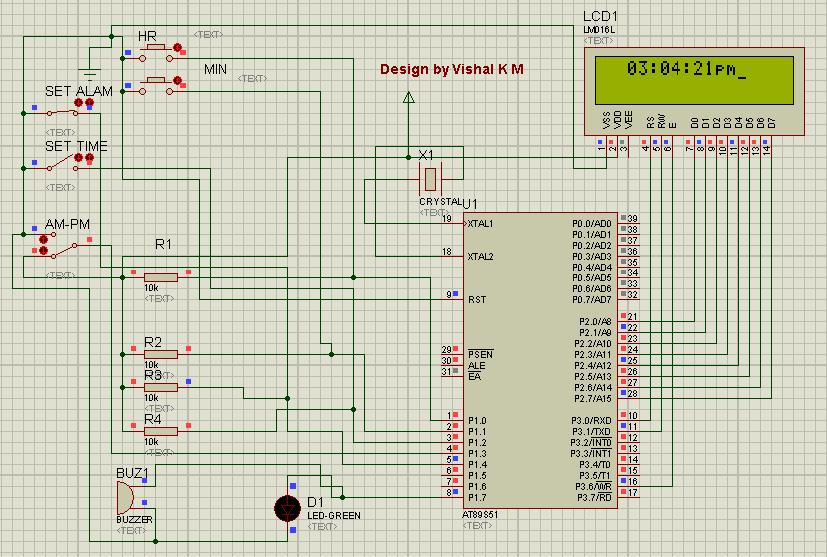
LCD based digital alarm clock using 89S51 microcontroller

 Circuit Diagram
An alarm clock is a clock that indicates a pre-set time by producing sound at that time. This functionality of digital clock is used to awaken people or remind them of something. A digital clock is one that displays time digitally. The project explained here, displays time on a 16x2 LCD module. The LCD is interfaced with 8051 microcontroller (AT89S51). This circuit can be used in cars, houses, offices etc.

This clock works in 12 hour mode and is configured by programming the microcontroller AT89S51. The program uses a delay function for producing a delay of 1 second.
The connections in the circuit are as following: port P2 of microcontroller is used as data input port which is connected to data pins (7-14) of LCD. P3^0, P3^1 and P3^6 pins of microcontroller are connected to control pins RS, RW and EN of LCD. P1^0, P1^1, P1^2 and P1^3 pins of microcontroller are connected to tactile switches to take manual inputs.

On reset, the LCD prompts the user to set alarm. Only the hour and minute components can be set by pressing the corresponding switches, repeatedly. These switches are made active low and so they provide ground to the corresponding input pins of the microcontroller AT89S51. The AM/PM mode is set by toggling the switch between ground and Vcc. Ground would set the clock in AM mode while Vcc would set it in PM mode.


After that the LCD prompts the user to set time. Only the hour and minute components can be set by pressing the corresponding switches, repeatedly. These switches are made active low and so they provide ground to the corresponding input pins of the controller. The AM/PM mode is set by toggling the switch between ground and Vcc. Ground would set the clock in AM mode while Vcc would set it in PM mode. The clock starts when start pin is connected to Vcc by pressing the switch.

The set time is displayed on LCD screen and changes as the time passes on. Seconds are increased after every one second by making use of delay function. As second reaches 59, minute is incremented by one and second is reset to 0. Similarly, as minute reaches 59, hour is increased by one and minute is set to 0. After hour reaches 11, minute reaches 59 and second reaches 59, all of them are set to 0 and the AM/PM mode is changed accordingly.

When the clock time becomes equal to the alarm time, a message ‘Alarm’ is displayed on LCD and alarm pin of microcontroller goes high for some duration. This pin can be connected to a speaker or buzzer to sound the alarm at the pre-set time.

PIC Countdown Timer (0-99)


This project describes how to program PIC16F628A to function as a 00-99 min programmable timer. User can set any time between 00-99 minutes and can turn ON a device for that period. The device will be automatically turned OFF after the time expires. For demonstration, the ON/OFF condition of device is simulated by switching LED ON and OFF. With the use of three input switches (unit, ten, start/stop) the user can set ON time of the timer and can also control Start/Stop operation. The two time set switches are for selecting unit and tens digit of minute time interval (00-99). Once you set the value of minute interval, pressing the Start/Stop will turn the timer ON (LED will glow), and pressing the same button again at any point of time during timer operation will interrupt the process (LED will turn OFF) and the timer will be reset. LCD display will provide timer status and user interface for setting time.


Circuit


Code
Compiled using MikroC for PIC


/*
  ############################################


  MCU:16F628A
  Project: PIC Countdown Timer (0-99)
  Vishal K M
  Jan 10, 2012
  ############################################

 
*/

// LCD module connections
sbit LCD_RS at RA0_bit;
sbit LCD_EN at RA1_bit;
sbit LCD_D4 at RB4_bit;
sbit LCD_D5 at RB5_bit;
sbit LCD_D6 at RB6_bit;
sbit LCD_D7 at RB7_bit;
sbit LCD_RS_Direction at TRISA0_bit;
sbit LCD_EN_Direction at TRISA1_bit;
sbit LCD_D4_Direction at TRISB4_bit;
sbit LCD_D5_Direction at TRISB5_bit;
sbit LCD_D6_Direction at TRISB6_bit;
sbit LCD_D7_Direction at TRISB7_bit;
// End LCD module connections

// Tact switches and Relay ports
sbit Relay at RA3_bit;
sbit SS_Select at RB0_bit;    // Start Stop Timer Select
sbit Unit_Button at RB1_bit;  // Set unit min
sbit Ten_Button at RB2_bit;   // Set ten min


// Messages
char Message1[]="Timer by VISHAL";
char Message2[]="Device ON";
char Message3[]="Device OFF";
char Message4[]="Set Time:    min";
char Message5[]="Time Left:   min";
unsigned short i, j, unit=0, ten=0, ON_OFF=0, index=0, clear, time;
char *digit = "00";
// 300ms Delay
void Delay_300(){
 Delay_ms(300);
}

void Display_Digits(){
 digit[1]=unit+48;
 digit[0]=ten+48;
 Lcd_Out(2,11,digit);
}

void start_timer(unsigned short MinVal){
 unsigned short temp1, temp2;
 Relay = 1;
 ON_OFF = 1;
 Lcd_Cmd(_LCD_CLEAR);
 Lcd_Out(1,1,Message2);
 Lcd_Out(2,1,Message5);
 OPTION_REG = 0x80 ;
 INTCON = 0x90;
 for (i=0; i<MinVal; i++){
  temp1 = (MinVal-i)%10 ;
  temp2 = (MinVal-i)/10 ;
  Lcd_Chr(2, 12, temp2+48);
  Lcd_Chr(2, 13, temp1+48);
  j=1;
  do {
  Delay_ms(1000);
  j++;
  } while(((j<=60) && (Clear ==0)));
  if (Clear) {
   Relay = 0;
   Delay_ms(500);
   Lcd_Out(1,1,Message3);
   INTCON = 0x00;
   goto stop;
   }
 }
 stop:
 Relay = 0;
 ON_OFF = 0;
 unit = 0;
 ten = 0;
 clear = 1;
}

void interrupt(void){
  if (INTCON.INTF == 1)   // Check if INTF flag is set
   {
    Clear = 1;
    INTCON.INTF = 0;       // Clear interrupt flag before exiting ISR
   }
  }

void main() {
  CMCON  |= 7;                       // Disable Comparators
  TRISB = 0b00001111;
  TRISA = 0b11110000;
  Relay = 0;

  Lcd_Init();                        // Initialize LCD
 start:
  clear = 0;
  Lcd_Cmd(_LCD_CLEAR);               // Clear display
  Lcd_Cmd(_LCD_CURSOR_OFF);          // Cursor off
  Lcd_Out(1,1,Message1);
  Lcd_Out(2,1,Message4);
  Display_Digits()  ;
 do {

     if(!Unit_Button){
     Delay_300();
     unit ++;
     if(unit==10) unit=0;
     Display_Digits();
    } // If !Unit_Button

    if(!Ten_Button){
     Delay_300();
     ten ++;
     if(ten==10) ten=0;
     Display_Digits();
    } // If !Ten_Button

    if(!SS_Select){
     Delay_300();
     time = ten*10+unit ;
     if(time > 0) start_timer(time);
    } // If !SS_Select

    if(clear){
     goto start;
    }
   } while(1);
}


Facebook page 

2012, Java IEEE Project Abstracts - Part 4

JAVA IEEE 2012 PROJECT ABSTRACTS

DOMAIN - SOFTWARE ENGINEERING
QOS ASSURANCE FOR DYNAMIC RECONFIGURATION OF COMPONENT-BASED SOFTWARE SYSTEMS
A major challenge of dynamic reconfiguration is Quality of Service (QoS) assurance, which is meant to reduce application disruption to the minimum for the system’s transformation. However, this problem has not been well studied.
This paper investigates the problem for component-based software systems from three points of view.
First, the whole spectrum of QoS characteristics is defined. Second, the logical and physical requirements for QoS characteristics are analyzed and solutions to achieve them are proposed. Third, prior work is classified by QoS characteristics and then realized by abstract reconfiguration strategies.
On this basis, quantitative evaluation of the QoS assurance abilities of existing work and our own approach is conducted through three steps. First, a proof-of-concept prototype called the reconfigurable component model is implemented to support the representation and testing of the reconfiguration strategies.
Second, a reconfiguration benchmark is proposed to expose the whole spectrum of QoS problems. Third, each reconfiguration strategy is tested against the benchmark and the testing results are evaluated. The most important conclusion from our investigation is that the classified QoS characteristics can be fully achieved under some acceptable constraints


*------------*------------*------------*------------*------------*------------*

DOMAIN - SOFTWARE ENGINEERING
EXPLOITING DYNAMIC INFORMATION IN IDES IMPROVES SPEED AND CORRECTNESS OF SOFTWARE MAINTENANCE TASKS
Modern IDEs such as Eclipse offer static views of the source code, but such views ignore information about the runtime behavior of software systems. Since typical object-oriented systems make heavy use of polymorphism and dynamic binding, static views will miss key information about the runtime architecture.
In this paper, we present an approach to gather and integrate dynamic information in the Eclipse IDE with the goal of better supporting typical software maintenance activities. By means of a controlled experiment with 30 professional developers, we show that for typical software maintenance tasks, integrating dynamic information into the Eclipse IDE yields a significant 17.5 percent decrease of time spent while significantly increasing the correctness of the solutions by 33.5 percent. We also provide a comprehensive performance evaluation of our approach


*------------*------------*------------*------------*------------*------------*
 
DOMAIN - SOFTWARE ENGINEERING
COMPARING THE DEFECT REDUCTION BENEFITS OF CODE INSPECTION AND TEST-DRIVEN DEVELOPMENT
This study is a quasi experiment comparing the software defect rates and implementation costs of two methods of software defect reduction: code inspection and test-driven development.
We divided participants, consisting of junior and senior computer science students at a large Southwestern university, into four groups using a two-by-two, between-subjects, factorial design and asked them to complete the same programming assignment using either test-driven development, code inspection, both, or neither.
We compared resulting defect counts and implementation costs across groups. We found that code inspection is more effective than test-driven development at reducing defects, but that code inspection is also more expensive. We also found that test-driven development was no more effective at reducing defects than traditional programming methods.


*------------*------------*------------*------------*------------*------------*

DOMAIN - SOFTWARE ENGINEERING
AN AUTONOMOUS ENGINE FOR SERVICES CONFIGURATION AND DEPLOYMENT
The runtime management of the infrastructure providing service-based systems is a complex task, up to the point where manual operation struggles to be cost effective. As the functionality is provided by a set of dynamically composed distributed services, in order to achieve a management objective multiple operations have to be applied over the distributed elements of the managed infrastructure.
Moreover, the manager must cope with the highly heterogeneous characteristics and management interfaces of the runtime resources. With this in mind, this paper proposes to support the configuration and deployment of services with an automated closed control loop.
The automation is enabled by the definition of a generic information model, which captures all the information relevant to the management of the services with the same abstractions, describing the runtime elements, service dependencies, and business objectives.
On top of that, a technique based on satisfiability is described which automatically diagnoses the state of the managed environment and obtains the required changes for correcting it (e.g., installation, service binding, update, or configuration). The results from a set of case studies extracted from the banking domain are provided to validate the feasibility of this proposal.


*------------*------------*------------*------------*------------*------------*
 
DOMAIN - SOFTWARE ENGINEERING
STAKERARE: USING SOCIAL NETWORKS AND COLLABORATIVE FILTERING FOR LARGE-SCALE REQUIREMENTS ELICITATION
Requirements elicitation is the software engineering activity in which stakeholder needs are understood. It involves identifying and prioritizing requirements—a process difficult to scale to large software projects with many stakeholders.
This paper proposes StakeRare, a novel method that uses social networks and collaborative filtering to identify and prioritize requirements in large software projects. StakeRare identifies stakeholders and asks them to recommend other stakeholders and stakeholder roles, builds a social network with stakeholders as nodes and their recommendations as links, and prioritizes stakeholders using a variety of social network measures to determine their project influence.
It then asks the stakeholders to rate an initial list of requirements, recommends other relevant requirements to them using collaborative filtering, and prioritizes their requirements using their ratings weighted by their project influence. StakeRare was evaluated by applying it to a software project for a 30,000-user system, and a substantial empirical study of requirements elicitation was conducted.
Using the data collected from surveying and interviewing 87 stakeholders, the study demonstrated that StakeRare predicts stakeholder needs accurately and arrives at a more complete and accurately prioritized list of requirements compared to the existing method used in the project, taking only a fraction of the time.


*------------*------------*------------*------------*------------*------------*

DOMAIN - PARALLEL AND DISTRIBUTED SYSTEMS
ON THE HOP COUNT STATISTICS IN WIRELESS MULTIHOP NETWORKS SUBJECT TO FADING
Consider a wireless multihop network where nodes are randomly distributed in a given area following a homogeneous Poisson process. The hop count statistics, viz. the probabilities related to the number of hops between two nodes, are important for performance analysis of the multihop networks.
In this paper, we provide analytical results on the probability that two nodes separated by a known euclidean distance are k hops apart in networks subject to both shadowing and small-scale fading. Some interesting results are derived which have generic significance. For example, it is shown that the locations of nodes three or more hops away provide little information in determining the relationship of a node with other nodes in the network.
This observation is useful for the design of distributed routing, localization, and network security algorithms. As an illustration of the application of our results, we derive the effective energy consumption per successfully transmitted packet in end-to-end packet transmissions.
We show that there exists an optimum transmission range which minimizes the effective energy consumption. The results provide useful guidelines on the design of a randomly deployed network in a more realistic radio environment.


*------------*------------*------------*------------*------------*------------*
 
DOMAIN - PARALLEL AND DISTRIBUTED SYSTEMS
ON MAXIMIZING THE LIFETIME OF WIRELESS SENSOR NETWORKS USING VIRTUAL BACKBONE SCHEDULING
Wireless Sensor Networks (WSNs) are key for various applications that involve long-term and low-cost monitoring and actuating. In these applications, sensor nodes use batteries as the sole energy source.
Therefore, energy efficiency becomes critical. We observe that many WSN applications require redundant sensor nodes to achieve fault tolerance and Quality of Service (QoS) of the sensing.
However, the same redundancy may not be necessary for multihop communication because of the light traffic load and the stable wireless links. In this paper, we present a novel sleep-scheduling technique called Virtual Backbone Scheduling (VBS). VBS is designed for WSNs has redundant sensor nodes.
VBS forms multiple overlapped backbones which work alternatively to prolong the network lifetime. In VBS, traffic is only forwarded by backbone sensor nodes, and the rest of the sensor nodes turn off their radios to save energy.
The rotation of multiple backbones makes sure that the energy consumption of all sensor nodes is balanced, which fully utilizes the energy and achieves a longer network lifetime compared to the existing techniques.
The scheduling problem of VBS is formulated as the Maximum Lifetime Backbone Scheduling(MLBS) problem. Since the MLBS problem is NP-hard, we propose approximation algorithms based on the Schedule Transition Graph (STG) and Virtual Scheduling Graph(VSG).
We also present an Iterative Local Replacement (ILR) scheme as a distributed implementation. Theoretical analyses and simulation studies verify that VBS is superior to the existing techniques


*------------*------------*------------*------------*------------*------------*
 
DOMAIN - PARALLEL AND DISTRIBUTED SYSTEMS
FLASH CROWD IN P2P LIVE STREAMING SYSTEMS: FUNDAMENTAL CHARACTERISTICS AND DESIGN IMPLICATIONS
Peer-to-peer (P2P) live video streaming systems have recently received substantial attention, with commercial deployment gaining increased popularity in the internet.
It is evident from our practical experiences with real-world systems that, it is not uncommon for hundreds of thousands of users to choose to join a program in the first few minutes of a live broadcast.
Such a severe flash crowd phenomenon in live streaming poses significant challenges in the system design.
In this paper, for the first time, we develop a mathematical model to: 1) capture the fundamental relationship between time and scale in P2P live streaming systems under a flash crowd, and 2) explore the design principle of population control to alleviate the impact of the flash crowd.
We carry out rigorous analysis that brings forth an in-depth understanding on effects of the gossip protocol and peer dynamics. In particular, we demonstrate that there exists an upper bound on the system scale with respect to a time constraint.
By trading peer startup delays in the initial stage of a flash crowd for system scale, we design a simple and flexible population control framework that can alleviate the flash crowd without the requirement of otherwise costly server deployment


*------------*------------*------------*------------*------------*------------*

DOMAIN - PARALLEL AND DISTRIBUTED SYSTEMS
EXPLORING THE OPTIMAL REPLICATION STRATEGY IN P2P-VOD SYSTEMS: CHARACTERIZATION AND EVALUATION
P2P-Video-on-Demand (P2P-VoD) is a popular Internet service which aims to provide a scalable and high-quality service to users. At the same time, content providers of P2P-VoD services also need to make sure that the service is operated with a manageable operating cost.
Given the volume-based charging model by ISPs, P2P-VoD content providers would like to reduce peers’ access to the content server so as to reduce the operating cost.
In this paper, we address an important open problem: what is the “ optimal replication ratio” in a P2P-VoD system such that peers will receive service from each other and at the same time, reduce the access to the content server? We address two fundamental issues: 1) what is the optimal replication ratio of a movie if w e know its popularity, and 2) how to achieve these optimal ratios in a distributed and dynamic fashion.
We first formally show how movie popularities can impact server’s workload, and formulate the video replication as an optimization problem. We show that the conventional wisdom of using the proportional replication strategy is “ suboptimal,” and expand the design space to both “ passive replacement policy” and “ active push policy ” to achieve the optimal replication ratios.
We consider practical implementation issues, evaluate the performance of P2P-VoD systems and show how to greatly reduce server’s workload and improve streaming quality via our distributed algorithms


*------------*------------*------------*------------*------------*------------*
 
DOMAIN - PARALLEL AND DISTRIBUTED SYSTEMS
ENERGY-EFFICIENT TOPOLOGY CONTROL IN COOPERATIVE AD HOC NETWORKS
Cooperative communication (CC) exploits space diversity through allowing multiple nodes cooperatively relay signals to the receiver so that the combined signal at the receiver can be correctly decoded. Since CC can reduce the transmission power and extend the transmission coverage, it has been considered in topology control protocols
However, prior research on topology control with CC only focuses on maintaining the network connectivity, minimizing the transmission power of each node, whereas ignores the energy efficiency of paths in constructed topologies.
This may cause inefficient routes and hurt the overall network performance in cooperative ad hoc networks. In this paper, to address this problem, we introduce a new topology control problem: energy-efficient topology control problem with cooperative communication, and propose two topology control algorithms to build cooperative energy spanners in which the energy efficiency of individual paths are guaranteed.
Both proposed algorithms can be performed in distributed and localized fashion while maintaining the globally efficient paths. Simulation results confirm the nice performance of all proposed algorithms


*------------*------------*------------*------------*------------*------------*

DOMAIN - PARALLEL AND DISTRIBUTED SYSTEMS
EMBEDDED TRANSITIVE CLOSURE NETWORK FOR RUNTIME DEADLOCK DETECTION IN NETWORKS-ON-CHIP
Interconnection networks with adaptive routing are susceptible to deadlock, which could lead to performance degradation or system failure. Detecting deadlocks at runtime is challenging because of their highly distributed characteristics.
In this paper, we present a deadlock detection method that utilizes runtime transitive closure (TC) computation to discover the existence of deadlock-equivalence sets, which imply loops of requests in networks-on-chip (NoCs). This detection scheme guarantees the discovery of all true deadlocks without false alarms in contrast with state-of-the-art approximation and heuristic approaches.
A distributed TC-network architecture, which couples with the NoC infrastructure, is also presented to realize the detection mechanism efficiently. Detailed hardware realization architectures and schematics are also discussed.
Our results based on a cycle-accurate simulator demonstrate the effectiveness of the proposed method. It drastically outperforms timing-based deadlock detection mechanisms by eliminating false detections and, thus, reducing energy wastage in retransmission for various traffic scenarios including real-world application.
We found that timing-based methods may produce two orders of magnitude more deadlock alarms than the TC-network method. Moreover, the implementations presented in this paper demonstrate that the hardware overhead of TC-networks is insignificant.


*------------*------------*------------*------------*------------*------------*
 
DOMAIN - PARALLEL AND DISTRIBUTED SYSTEMS
EFFICIENT HARDWARE BARRIER SYNCHRONIZATION IN MANY-CORE CMPS
Traditional software-based barrier implementations for shared memory parallel machines tend to produce hotspots in terms of memory and network contention as the number of processors increases. This could limit their applicability to future many-core CMPs in which possibly several dozens of cores would need to be synchronized efficiently.
In this work, we develop GBarrier, a hardware-based barrier mechanism especially aimed at providing efficient barriers in future many-core CMPs.
Our proposal deploys a dedicated G-line-based network to allow for fast and efficient signaling of barrier arrival and departure. Since GBarrier does not have any influence on the memory system, we avoid all coherence activity and barrier-related network traffic that traditional approaches introduce and that restrict scalability.
Through detailed simulations of a 32-core CMP, we compare GBarrier against one of the most efficient software-based barrier implementations for a set of kernels and scientific applications. Evaluation results show average reductions of 54 and 21 percent in execution time, 53 and 18 percent in network traffic, and also 76 and 31 percent in the energy-delay 2 product metric for the full CMP when the kernels and scientific applications, respectively, are considered


*------------*------------*------------*------------*------------*------------*
 
DOMAIN - PARALLEL AND DISTRIBUTED SYSTEMS
DYNAMIC BEACON MOBILITY SCHEDULING FOR SENSOR LOCALIZATION
In mobile-beacon assisted sensor localization, beacon mobility scheduling aims to determine the best beacon trajectory so that each sensor receives sufficient beacon signals and becomes localized with minimum delay.
We propose a novel DeteRministic dynamic bEAcon Mobility Scheduling (DREAMS) algorithm, without requiring any prior knowledge of the sensory field. In this algorithm, the beacon trajectory is defined as the track of Depth-First Traversal (DFT) of the network graph, thus deterministic.
The mobile beacon performs DFT dynamically, under the instruction of nearby sensors on the fly. It moves from sensor to sensor in an intelligent heuristic manner according to Received Signal Strength (RSS)-based distance measurements. We prove that DREAMS guarantees full localization (every sensor is localized) when the measurements are noise-free, and derive the upper bound of beacon total moving distance in this case.
Then, we suggest to apply node elimination and Local Minimum Spanning Tree (LMST) to shorten beacon tour and reduce delay. Further, we extend DREAMS to multibeacon scenarios. Beacons with different coordinate systems compete for localizing sensors. Loser beacons agree on winner beacons’ coordinate system, and become cooperative in subsequent localization.
All sensors are finally localized in a commonly agreed coordinate systems. Through simulation we show that DREAMS guarantees full localization even with noisy distance measurements. We evaluate its performance on localization delay and communication overhead in comparison with a previously proposed static path-based scheduling method


*------------*------------*------------*------------*------------*------------*
 
DOMAIN - PARALLEL AND DISTRIBUTED SYSTEMS
DRAGON: DETECTION AND TRACKING OF DYNAMIC AMORPHOUS EVENTS IN WIRELESS SENSOR NETWORKS
Wireless sensor networks may be deployed in many applications to detect and track events of interest. Events can be either point events with an exact location and constant shape, or region events which cover a large area and have dynamic shapes.
While both types of events have received attention, no event detection and tracking protocol in existing wireless sensor network research is able to identify and track region events with dynamic identities, which arise when events are created or destroyed through splitting and merging. In this paper, we propose DRAGON, an event detection and tracking protocol which is able to handle all types of events including region events with dynamic identities.
DRAGON employs two physics metaphors: event center of mass, to give an approximate location to the event; andnode momentum, to guide the detection of event merges and splits.
Both detailed theoretical analysis and extensive performance studies of DRAGON’s properties demonstrate that DRAGON’s execution is distributed among the sensor nodes, has low latency, is energy efficient, is able to run on a wide array of physical deployments, and has performance which scales well with event size, speed, and count.


*------------*------------*------------*------------*------------*------------*

DOMAIN - PARALLEL AND DISTRIBUTED SYSTEMS
DISTRIBUTED DIAGNOSIS OF DYNAMIC EVENTS IN PARTITIONABLE ARBITRARY TOPOLOGY NETWORKS
This work introduces the Distributed Network Reachability(DNR) algorithm, a distributed system-level diagnosis algorithm that allows every node of a partitionable arbitrary topology network to determine which portions of the network are reachable and unreachable.
DNR is the first distributed diagnosis algorithm that works in the presence of network partitions and healings caused by dynamic fault and repair events. Both crash and timing faults are assumed, and a faulty node is indistinguishable of a network partition. Every link is alternately tested by one of its adjacent nodes at subsequent testing intervals. Upon the detection of a new event, the new diagnostic information is disseminated to reachable nodes.
New events can occur before the dissemination completes. Any time a new event is detected or informed, a working node may compute the network reachability using local diagnostic information. The bounded correctness of DNR is proved, including the bounded diagnostic latency, bounded startup and accuracy.
Simulation results are presented for several random and regular topologies, showing the performance of the algorithm under highly dynamic fault situations


*------------*------------*------------*------------*------------*------------*
 
DOMAIN - PARALLEL AND DISTRIBUTED SYSTEMS
COST-DRIVEN SCHEDULING OF GRID WORKFLOWS USING PARTIAL CRITICAL PATHS
Recently, utility Grids have emerged as a new model of service provisioning in heterogeneous distributed systems. In this model, users negotiate with service providers on their required Quality of Service and on the corresponding price to reach a Service Level Agreement.
One of the most challenging problems in utility Grids is workflow scheduling, i.e., the problem of satisfying the QoS of the users as well as minimizing the cost of workflow execution. In this paper, we propose a new QoS-based workflow scheduling algorithm based on a novel concept called Partial Critical Paths (PCP), that tries to minimize the cost of workflow execution while meeting a user-defined deadline.
The PCP algorithm has two phases: in the deadline distribution phase it recursively assigns subdeadlines to the tasks on the partial critical paths ending at previously assigned tasks, and in the planning phase it assigns the cheapest service to each task while meeting its subdeadline. The simulation results show that the performance of the PCP algorithm is very promising


*------------*------------*------------*------------*------------*------------*
 
DOMAIN - PARALLEL AND DISTRIBUTED SYSTEMS
COMPARISON-BASED SYSTEM-LEVEL FAULT DIAGNOSIS: A NEURAL NETWORK APPROACH
We consider the fault identification problem, also known as the system-level self-diagnosis, in multiprocessor and multicomputer systems using the comparison approach. In this diagnosis model, a set of tasks is assigned to pairs of nodes and their outcomes are compared by neighboring nodes.
Given that comparisons are performed by the nodes themselves, faulty nodes can incorrectly claim that fault-free nodes are faulty or that faulty ones are fault-free. The collections of all agreements and disagreements, i.e., the comparison outcomes, among the nodes are used to identify the set of permanently faulty nodes.
Since the introduction of the comparison model, significant progress has been made in both theory and practice associated with the original model and its offshoots. Nevertheless, the problem of efficiently identifying the set of faulty nodes when not all the comparison outcomes are available to the diagnosis algorithm at the beginning of the diagnosis phase, i.e., partial syndromes, remains an outstanding research issue.
In this paper, we introduce a novel diagnosis approach using neural networks to solve this fault identification problem using partial syndromes. Results from a thorough simulation study demonstrate the effectiveness of the neural-network-based self-diagnosis algorithm for randomly generated diagnosable systems of different sizes and under various fault scenarios.
We have then conducted extensive simulations using partial syndromes and nondiagnosable systems. Simulations showed that the neural-network-based diagnosis approach provided good results making it a viable addition or alternative to existing diagnosis algorithms


*------------*------------*------------*------------*------------*------------*
 
DOMAIN - PARALLEL AND DISTRIBUTED SYSTEMS
CATCHING PACKET DROPPERS AND MODIFIERS IN WIRELESS SENSOR NETWORKS
Packet dropping and modification are common attacks that can be launched by an adversary to disrupt communication in wireless multihop sensor networks. Many schemes have been proposed to mitigate or tolerate such attacks, but very few can effectively and efficiently identify the intruders.
To address this problem, we propose a simple yet effective scheme, which can identify misbehaving forwarders that drop or modify packets. Extensive analysis and simulations have been conducted to verify the effectiveness and efficiency of the scheme


*------------*------------*------------*------------*------------*------------*
 
DOMAIN - PARALLEL AND DISTRIBUTED SYSTEMS
CASHING IN ON THE CACHE IN THE CLOUD
Over the past decades, caching has become the key technology used for bridging the performance gap across memory hierarchies via temporal or spatial localities; in particular, the effect is prominent in disk storage systems. Applications that involve heavy I/O activities, which are common in the cloud, probably benefit the most from caching.
The use of local volatile memory as cache might be a natural alternative, but many well-known restrictions, such as capacity and the utilization of host machines, hinder its effective use. In addition to technical challenges, providing cache services in clouds encounters a major practical issue (quality of service or service level agreement issue) of pricing. Currently, (public) cloud users are limited to a small set of uniform and coarse-grained service offerings, such as High-Memory and High-CPU in Amazon EC2.
In this paper, we present the cache as a service (CaaS) model as an optional service to typical infrastructure service offerings. Specifically, the cloud provider sets aside a large pool of memory that can be dynamically partitioned and allocated to standard infrastructure services as disk cache.
We first investigate the feasibility of providing CaaS with the proof-of-concept elastic cache system (using dedicated remote memory servers) built and validated on the actual system, and practical benefits of CaaS for both users and providers (i.e., performance and profit, respectively) are thoroughly studied with a novel pricing scheme.
Our CaaS model helps to leverage the cloud economy greatly in that 1) the extra user cost for I/O performance gain is minimal if ever exists, and 2) the provider’s profit increases due to improvements in server consolidation resulting from that performance gain. Through extensive experiments with eight resource allocation strategies, we demonstrate that our CaaS model can be a promising cost-efficient solution for both users and providers


*------------*------------*------------*------------*------------*------------*
 
DOMAIN - PARALLEL AND DISTRIBUTED SYSTEMS
AN ONLINE DATA ACCESS PREDICTION AND OPTIMIZATION APPROACH FOR DISTRIBUTED SYSTEMS
Current scientific applications have been producing large amounts of data. The processing, handling and analysis of such data require large-scale computing infrastructures such as clusters and grids.
In this area, studies aim at improving the performance of data-intensive applications by optimizing data accesses. In order to achieve this goal, distributed storage systems have been considering techniques of data replication, migration, distribution, and access parallelism.
However, the main drawback of those studies is that they do not take into account application behavior to perform data access optimization. This limitation motivated this paper which applies strategies to support the online prediction of application behavior in order to optimize data access operations on distributed systems, without requiring any information on past executions. In order to accomplish such a goal, this approach organizes application behaviors as time series and, then, analyzes and classifies those series according to their properties.
By knowing properties, the approach selects modeling techniques to represent series and perform predictions, which are, later on, used to optimize data access operations. This new approach was implemented and evaluated using the OptorSim simulator, sponsored by the LHC-CERN project and widely employed by the scientific community.
Experiments confirm this new approach reduces application execution time in about 50 percent, specially when handling large amounts of data


*------------*------------*------------*------------*------------*------------*

DOMAIN - PARALLEL AND DISTRIBUTED SYSTEMS
A SURVEY OF PARALLEL PROGRAMMING MODELS AND TOOLS IN THE MULTI AND MANY-CORE ERA
In this work, we present a survey of the different parallel programming models and tools available today with special consideration to their suitability for high-performance computing. Thus, we review the shared and distributed memory approaches, as well as the current heterogeneous parallel programming model.
In addition, we analyze how the partitioned global address space (PGAS) and hybrid parallel programming models are used to combine the advantages of shared and distributed memory systems. The work is completed by considering languages with specific parallel support and the distributed programming paradigm. In all cases, we present characteristics, strengths, and weaknesses.
The study shows that the availability of multi-core CPUs has given new impulse to the shared memory parallel programming approach. In addition, we find that hybrid parallel programming is the current way of harnessing the capabilities of computer clusters with multi-core nodes.
On the other hand, heterogeneous programming is found to be an increasingly popular paradigm, as a consequence of the availability of multi-core CPUs+GPUs systems. The use of open industry standards like OpenMP, MPI, or OpenCL, as opposed to proprietary solutions, seems to be the way to uniformize and extend the use of parallel programming models


*------------*------------*------------*------------*------------*------------*
 
DOMAIN - PARALLEL AND DISTRIBUTED SYSTEMS
A SEQUENTIALLY CONSISTENT MULTIPROCESSOR ARCHITECTURE FOR OUT-OF-ORDER RETIREMENT OF INSTRUCTIONS
Out-of-order retirement of instructions has been shown to be an effective technique to increase the number of in-flight instructions. This form of runtime scheduling can reduce pipeline stalls caused by head-of-line blocking effects in the reorder buffer (ROB).
Expanding the width of the instruction window can be highly beneficial to multiprocessors that implement a strict memory model, especially when both loads and stores encounter long latencies due to cache misses, and whose stalls must be overlapped with instruction execution to overcome the memory latencies.
Based on the Validation Buffer (VB) architecture (a previously proposed out-of-order retirement, checkpoint-free architecture for single processors), this paper proposes a cost-effective, scalable, out-of-order retirement multiprocessor, capable of enforcing sequential consistency without impacting the design of the memory hierarchy or interconnect.
Our simulation results indicate that utilizing a VB can speed up both relaxed and sequentially consistent in-order retirement in future multiprocessor systems by between 3 and 20 percent, depending on the ROB size


*------------*------------*------------*------------*------------*------------*
 
DOMAIN - PARALLEL AND DISTRIBUTED SYSTEMS
A SECURE ERASURE CODE-BASED CLOUD STORAGE SYSTEM WITH SECURE DATA FORWARDING
A cloud storage system, consisting of a collection of storage servers, provides long-term storage services over the Internet. Storing data in a third party’s cloud system causes serious concern over data confidentiality.
General encryption schemes protect data confidentiality, but also limit the functionality of the storage system because a few operations are supported over encrypted data. Constructing a secure storage system that supports multiple functions is challenging when the storage system is distributed and has no central authority.
We propose a threshold proxy re-encryption scheme and integrate it with a decentralized erasure code such that a secure distributed storage system is formulated. The distributed storage system not only supports secure and robust data storage and retrieval, but also lets a user forward his data in the storage servers to another user without retrieving the data back.
The main technical contribution is that the proxy re-encryption scheme supports encoding operations over encrypted messages as well as forwarding operations over encoded and encrypted messages. Our method fully integrates encrypting, encoding, and forwarding.
We analyze and suggest suitable parameters for the number of copies of a message dispatched to storage servers and the number of storage servers queried by a key server. These parameters allow more flexible adjustment between the number of storage servers and robustness


*------------*------------*------------*------------*------------*------------*

DOMAIN - PARALLEL AND DISTRIBUTED SYSTEMS
TRUSTWORTHY COORDINATION OF WEB SERVICES ATOMIC TRANSACTIONS
The Web Services Atomic Transactions (WS-AT) specification makes it possible for businesses to engage in standard distributed transaction processing over the Internet using Web Services technology. For such business applications, trustworthy coordination of WS-AT is crucial.
In this paper, we explain how to render WS-AT coordination trustworthy by applying Byzantine Fault Tolerance (BFT) techniques. More specifically, we show how to protect the core services described in the WS-AT specification, namely, the Activation service, the Registration service, the Completion service and the Coordinator service, against Byzantine faults.
The main contribution of this work is that it exploits the semantics of the WS-AT services to minimize the use of yzantine Agreement (BA), instead of applying BFT techniques naively, which would be prohibitively expensive.
We have incorporated our BFT protocols and mechanisms into an open-source framework that implements the WS-AT specification. The resulting BFT framework for WS-AT is useful for business applications that are based on WS-AT and that require a high degree of dependability, security, and trust


*------------*------------*------------*------------*------------*------------*
 
DOMAIN - PARALLEL AND DISTRIBUTED SYSTEMS
A NETWORK CODING EQUIVALENT CONTENT DISTRIBUTION SCHEME FOR EFFICIENT PEER-TO-PEER INTERACTIVE VOD STREAMING
Although random access operations are desirable for on-demand video streaming in peer-to-peer systems, they are difficult to efficiently achieve due to the asynchronous interactive behaviors of users and the dynamic nature of peers.
In this paper, we propose a network coding equivalent content distribution (NCECD) scheme to efficiently handle interactive video-on-demand (VoD) operations in peer-to-peer systems. In NCECD, videos are divided into segments that are then further divided into blocks. These blocks are encoded into independent blocks that are distributed to different peers for local storage.
With NCECD, a new client only needs to connect to a sufficient number of parent peers to be able to view the whole video and rarely needs to find new parents when performing random access operations. In most existing methods, a new client must search for parent peers containing specific segments; however, NCECD uses the properties of network coding to cache equivalent content in peers, so that one can pick any parent without additional searches.
Experimental results show that the proposed scheme achieves low startup and jump searching delays and requires fewer server resources. In addition, we present the analysis of system parameters to achieve reasonable block loss rates for the proposed scheme

8051 programmer kit


All the student's may not properly works on microcontroller because  shortage of programmer kit(burner kit) whatever the  problem they have ,so now you can make your own programmer kit for 8051 microcontroller and can make more practical application and learn more efficiently in this field.For making the programmer kit we make the circuit step by step.
FOR P89V51RD2 microcontroller


Power Supply


  • Power supply 

  • DB9 connector

  • Line driver circuit

  • 8051 

  • final circuit of Programmer kit


1.  POWER SUPPLY: Before making any circuit we need to design its power supply it consist of many part like step down, ac-dc conversion, voltage stabilizing etc but we will giving the power to our board from an 12-volt adapter so our power supply consist of a voltage regulator,capacitor,diode, led and connector. 


    7805 voltage regulator


    • 7805:-It is the voltage regulator ic as pin diagram is shown.

    • diode IN4007 and the silver line part is its negative.

    • resistor R1=330ohm or we can also use 470ohm because it is use with the led.

    • A 2 pin male connector is required for giving the power to the circuit the +ve will connect with 1 pin of 7805.

    • A 1000uf capacitor is also use with power supply to reducing the ripple or maintaining the continuity.

    • Led:-the cutted portion of the led is negative.


2.  DB9 CONNECTOR: DB9 connector is use to connect the computer with your  programmer board it uses the RS232 cable to connect the DB9 port has 9 pins each pin has its own function but we will use only pin no 2 , 3 and  5.


  • pin no 2 is known as recieved data bit when controller transmit the data bit then computer recive from this pin. This is connected to the 14th pin of max232.

  • pin no 3 is named as transmit data the data will transmit form the computer with the help of this pin and this is connected 13th pin of max232.

  • pin no 5 we make this pin normally ground.


3.  LINE DRIVER CIRCUIT: The MAX232 is an Integrated Circuit that convert signal from an RS232 serial port to signal suitable for use in ttl compaitable digital logic circuits.The MAX232 is a dual driver/receiver and typically converts the RX, TX, CTS and RTS signals.For more details of MAX232 you can download the datasheet of it form here. download  


  • here the values of all the capacitors are 0.1 uf.

  • 16 pin is vcc should be maintained at 5volt dc.

  • the 15th pin becomes ground.

  • T1out-pin is use to send the data serially to the computer.

  • R1in-pin is use to recieve the data from the computer serially.

  • T1in-pin is use to tramsmitt the data from microcontroller to MAX232 which is actually going to computer.

  • R1out-pin is use for send the incoming data from MAX232 to microcontroller which is actually come from computer.

  • Download the MAX232 datasheet here.download 

4.  8051: The basic 8051 circuit consist of reset circuitry and oscillator circuit but before this we will look the pin diagram of the 8051 that how or what pin's we are using to make our circuit.


8051 microcontroller


As we can see in the fig next that the 8051 microcontroller has 40 pin it has 32 pin I/O lines or we can 32 input and output lines .It consist of four 8bit port's thats why we call it 8bit microcontroller. For our circuit we only need 8 pins these are as follow.


  • We need a 40 pin IC base

  • RST this is the pin  no 9 called as reset pin this pin reset the program counter 0f 8051 microcontroller and it is active high.

  • XTAL1 and XTAL2 are for providing the oscillations to the controller.

  • 10 and 11th pin are use for serial communication.

  • 40th and 31st is to provide vcc basically set at 5volt.

  • 20th pin is become ground.

*The two basic circuit for 8051 microcontroller are listed below.


reset circuit


XTAL connection to8051

4.  FINAL PROGRAMMER CIRCUIT: When we connect the all small circuit with each other than the programmer circuit is in front of you and it is like below.


Mobile Operated robot(DTMF Tech.)


MOBILE OPERATED ROBOT: The robot is made for the purpose military operation, spy robot or navigator in forest.The mobile operated robot is a very small application of DTMF technology we showing you how we can use the DTMF to operate a robot  because the robot is operated by a mobile so the range of the robot communication is not limited its just depends on the network of the mobile and in present senario the mobile network is everywhere.


DTMF KEYPAD

DTMF: DTMF(Dual Tone Multi-Frequency) , better known as touch-tone is a system of signal tones in telecommunications.This technology is used in several of Applications for example voice mail, customer care,telephone banking etc.


There are twelve DTMF signals, each of which is made up of two tones from the following selection.

ROW'S- 697 Hz ,770 Hz ,852 Hz, 941 Hz.
COLUMN'S- 1209 Hz, 1336 Hz, 1447 Hz , 1633 Hz.

The tones are divided into two groups (low and high) , and each DTMF signal uses one of tone from each group. This prevents any harmonics from being misinterpreted as part of the signal.


DTMF DECODER PIN OUT


DTMF Decoder: The DTMF tone is decoded by the DTMF Decoder ic that is HT9170 which decoded a dtmf tone and gives a four bit data at the output of the decoder.Now this four bit data can be use  for  making the decision as for the key pressed on the mobile keypad the data have different for a different key.some important pin of HT9170 are listed below:-


1. Pin 15(DV data valid): The data valid pin is become high when the dtmf decoder receive a valid data or this pin hold's the 5v when the key is pressed.


2. Pin 10(OE output enable): This pin is use to enable the output when this pin is high the data pin are active and the decoded output is sent to the decoded pin.


3. Pin 11-14(D0-D3 data pins): These are the data pins which makes the 4 bit data after pressing a key on the mobile such as 0001 for pressing the key 1 and other are shown into the picture shown.

4. Pin X1 or X2: These pin's are use for providing the oscillation to the ic basically a xtal of 3.579 MHz is used here. for more details download the HT9170 datasheet .DOWNLOAD 

SOFTWARE:  For the program of this circuit click here 


CIRCUIT: The circuit is made in different modules


1.Power supply : For power supply just click here 


DTMF DATA OUTPUT


2.Input or DTMF decoder:


DTMF Application circuit


3.Decision (microcontroller 8051): For 8051 microcontroller circuit just click here  

4. Motor driver circuit:  The IC-l293d  is well known as motor driver this is 12v motor driver we use the motor driver IC because our micro-controller is work on 5v and the motor have different operating voltage. So to meet with these parameter we use these driver IC there are so many other IC available for different configuration.


The full circuit for mobile operated robot is as follow :


back & front view of circuit


robot


final robot


Dot Net Project Titles (IEEE 2012, 2011 Dot Net IEEE Project List)

DOT NET - CLOUD COMPUTING PROJECTS
CLOUD COMPUTING, 2012 IEEE PROJECT TITLES
* Cloud Chamber A Self-Organizing Facility to Create, Exercise, and Examine Software as a Service Tenants
* Cluster as a Service for self-deployable cloud applications
* A Cloud Infrastructure for Optimization of a Massive Parallel Sequencing Workflow
* A Multi-Objective Approach for Workflow Scheduling in Heterogeneous Environments
* Design and Implementation of a Secure Healthcare Social Cloud System
* Enhanced Energy-efficient Scheduling for Parallel Applications in Cloud
* A Price- and-Time-Slot-Negotiation Mechanism for Cloud Service Reservations
* A Seeded Cloud Approach to Health Cyberinfrastructure Preliminary Architecture Design and Case Applications
* A Time-series Pattern based Noise Generation Strategy for Privacy Protection in Cloud Computing
* An Autonomous Reliability Aware Negotiation Strategy for Cloud Computing Environments
* Mining Concept drifting Network traffic in cloud computing environments
* On Handling Large-Scale Polynomial Multiplications in Compute Cloud Environments using Divisible Load Paradigm
* Optical Networks for Grid and Cloud Computing Applications
* Automated Tagging for the Retrieval of Software Resources in Grid and Cloud Infrastructures
* Environmental and Disaster Sensing Using Cloud Computing Infrastructure
* Global Futures a Multithreaded Execution Model for Global Arrays-based Applications
* Optimal Reconfiguration of the Cloud Network for Maximum Energy Savings
* Performance Analysis of Cloud Computing Centers Using M =G=m=m_ r Queuing Systems
* Performance analysis of content-based mobile application on Content Delivery Networks
* Performance evaluation of multimedia services over wireless LAN using routing protocol Optimized Link State Routing (OLSR)
* Perspectives of UnaCloud An Opportunistic Cloud Computing Solution For Facilitating Research
* Pseudo Random Number Generation for Parallelized Jobs on Clusters
* Revenue Management for Cloud Providers - A Policy-based Approach under Stochastic Demand
* Scalable Join Queries in Cloud Data Stores
* SLA-based Optimization of Power and Migration Cost in Cloud Computing
* Time and Cost Sensitive Data-Intensive Computing on Hybrid Clouds
* Visualizing Nonmanifold and Singular Implicit Surfaces with Point Clouds

* CLOUDTPS: Scalable Transactions for Web Applications in the Cloud, IEEE 2011
* Enabling Public Auditability and Data Dynamics for Storage Security in Cloud Computing, IEEE 2011
* Heuristics Based Query Processing for Large RDF Graphs using Cloud Computing, IEEE 2011
* Improving Utilization of Infrastructure Clouds, IEEE 2011
* Multilevel intrusion detection system and log management in cloud computing, IEEE 2011
* Secure and Practical Outsourcing of Linear Programming in Cloud Computing, IEEE 2011
* Towards Secure and Dependable Storage Services in Cloud Computing, IEEE 2011
* Checkpoint-based Fault-tolerant Infrastructure for Virtualized Service Providers, IEEE 2010
* Dynamic Auction Mechanism for Cloud Resource Allocation, IEEE 2010
* Elastic Site - Using Clouds to Elastically Extend Site Resources, IEEE 2010
* Fuzzy Keyword Search over Encrypted Data in Cloud Computing, IEEE 2010
* Privacy-Preserving Public Auditing for Data Storage Security in Cloud Computing, IEEE 2010


DOT NET - MOBILE COMPUTING PROJECTS
MOBILE COMPUTING, 2012 IEEE PROJECTS
* A Fade-Level Skew-Laplace Signal Strength Model for Device-Free Localization with Wireless Networks
* A Novel MAC Scheme for Multichannel Cognitive Radio Ad Hoc Networks
* An MIMO Configuration Mode and MCS Level Selection Scheme by Fuzzy Q-Learning for HSPA Systems
* Channel Estimation for Opportunistic Spectrum Access Uniform and Random Sensing
* Characterizing the Security Implications of Third-Party Emergency Alert Systems over Cellular Text Messaging Services
* Delay Optimal Scheduling for Cognitive Radios with Cooperative Beamforming A Structured Matrix-Geometric Method
* Efficient Virtual Backbone Construction with Routing Cost Constraint in Wireless Networks Using Directional Antennas
* Energy-Efficient Cooperative Video Distribution with Statistical QoS Provisions over Wireless Networks
* Modeling and Performance Analysis for Duty-Cycled MAC Protocols with Applications to S-MAC and X-MAC
* Modeling and Performance Evaluation of Backoff Misbehaving Nodes in CSMACA Networks
* ProSpect A Proactive Spectrum Handoff Framework for Cognitive Radio Ad Hoc Networks without Common Control Channel
* STORM A Framework for Integrated Routing, Scheduling and Traffic Management in Ad Hoc Networks
* The Boomerang Protocol Tying Data to Geographic Locations in Mobile Disconnected Networks
* Two-Tiered Constrained Relay Node Placement in Wireless Sensor Networks Computational Complexity and Efficient Approximations

* A Distributed and Scalable Time Slot Allocation Protocol for Wireless Sensor Networks, IEEE 2011
* Autonomous Deployment of Heterogeneous Mobile Sensors, IEEE 2011
* Effective Scheduling in Infrastructure Based Cognitive Radio Networks, IEEE 2011
* Fast Detection of Mobile Replica node attacks in wireless sensor networks, IEEE 2011
* Minimum Bandwidth Reservations for Periodic Streams in Wireless Real-Time Systems, IEEE 2011
* Mobile Sampling of Sensor Field Data Using Controlled Broadcast, IEEE 2011
* Model and Protocol for Energy-Efficient Routing over Mobile Ad Hoc Networks, IEEE 2011
* Throughput Optimization in Mobile Backbone Networks, IEEE 2011
* A Scalable and Energy-Efficient Context Monitoring Framework for Mobile Personal Sensor Networks, IEEE 2010
* Combined Authentication-Based Multilevel Access Control in Mobile Application for DailyLifeService, IEEE 2010
* Energy-Optimal Scheduling with Dynamic Channel Acquisition in Wireless Downlinks, IEEE 2010
* On Multihop Distances in Wireless Sensor Networks with Random Node Locations, IEEE 2010
* Optimal Accounting Policies for AAA Systems in Mobile Telecommunications Networks, IEEE 2010
* VEBEK: Virtual Energy-Based Encryption and Keying for Wireless Sensor Networks, IEEE 2010
* A Flexible Privacy-Enhanced Location-Based Services System Framework and Practice, IEEE 2009
* A Tabu Searching Algorithm For Cluster Building in Wireless Sensor Networks, IEEE 2009
* Biased Random Walks in Uniform Wireless Networks, IEEE 2009
* Cell Breathing Techniques for Load Balancing in Wireless LANs, IEEE 2009
* An Gen3 based Authentication Protocol, IEEE 2009
* Contention-Aware Performance Analysis of Mobility-Assisted Routing, IEEE 2009
* Energy Maps For Mobile Wireless Networks, IEEE 2009
* Greedy Routing with Anti-Void Traversal for Wireless Sensor Networks, IEEE 2009
* Information Content-Based Sensor Selection and Transmission Power Adjustment for Collaborative Target Tracking, IEEE 2009
* Minimizing Recovery State in Geographic Ad Hoc Routing, IEEE 2009
* On the Planning of Wireless Sensor Networks Energy-Efficient Clustering under the Joint Route, IEEE 2009
* Opportunistic Scheduling with Reliability Guarantees in Cognitive Radio Networks, IEEE 2009
* Random Cast An Energy Efficient Communication Scheme for Mobile Ad Hoc Networks, IEEE 2009
* Route Stability in MANETs under the Random Direction Mobility Model, IEEE 2009

DOT NET - KNOWLEDGE & DATA ENGINEERING
KNOWLEDGE AND DATA ENGINEERING, 2012 IEEE PROJECTS
* A Decision-Theoretic Framework for Numerical Attribute Value Reconciliation
* Discriminative Feature Selection by Nonparametric Bayes Error Minimization
* EDISC A Class-Tailored Discretization Technique for Rule-Based Classification
* Effective and Efficient Shape-Based Pattern Detection over Streaming Time Series
* A Knowledge-Driven Approach to Activity Recognition in Smart Homes
* A Look-Ahead Approach to Secure Multiparty Protocols
* Adding Temporal Constraints to XML Schema
* Improving Aggregate Recommendation Diversity Using Ranking-Based Techniques
* Segmentation and Sampling of Moving Object Trajectories Based on Representativeness
* Using Rule Ontology in Repeated Rule Acquisition from Similar Web Sites
* Maximum Ambiguity-Based Sample Selection in Fuzzy Decision Tree Induction
* Protecting Location Privacy against Location-Dependent Attacks in Mobile Services
* Saturn Range Queries, Load Balancing and Fault Tolerance in DHT Data Systems
* Combining Tag and Value Similarity for Data Extraction and Alignment
* Data Mining for XML Query-Answering Support
* Dense Subgraph Extraction with Application to Community Detection
* Efficient and Progressive Algorithms for Distributed Skyline Queries over Uncertain Data
* Efficient Computation of Range Aggregates against Uncertain Location-Based Queries
* Energy Efficient Schemes for Accuracy-Guaranteed Sensor Data Aggregation Using Scalable Counting
* Energy-Efficient Reverse Skyline Query Processing over Wireless Sensor Networks
* A Performance Anomaly Detection and Analysis Framework for DBMS Development
* A Unified Probabilistic Framework for Name Disambiguation in Digital Library
* Evaluating Path Queries over Frequently Updated Route Collections
* Extending Recommender Systems for Disjoint UserItem Sets The Conference Recommendation Problem
* Fuzzy Orders-of-Magnitude-Based Link Analysis for Qualitative Alias Detection
* Mining Online Reviews for Predicting Sales Performance A Case Study in the Movie Domain
* On the Complexity of View Update Analysis and Its Application to Annotation Propagation
* Weakly Supervised Joint Sentiment-Topic Detection from Text

* A Generic Multilevel Architecture for Time Series Prediction, IEEE 2011
* A Personalized Ontology Model for Web Information Gathering, IEEE 2011
* A Web Search Engine-Based Approach to Measure Semantic Similarity between Words, IEEE 2011
* Energy time series forecasting based on pattern sequence similarity, IEEE 2011
* Optimal Service Pricing for a Cloud Cache, IEEE 2011
* Publishing Search Logs—A Comparative Study of Privacy Guarantees, IEEE 2011
* Data Leakge Detection, IEEE 2011
* Anonymous Query processing in Road Networks, IEEE 2010
* Automated classification of customer e mails via association rule mining, IEEE 2010
* ISO-MAP: Energy-Efficient Contour Mapping in Wireless Sensor Networks, IEEE 2010
* LIGHT: A Query-Efficient Yet Low-Maintenance Indexing Scheme over DHTs, IEEE 2010
* Record Matching over Query Results from Multiple Web Databases, IEEE 2010
* ViDE A Vision Based Approach for Deep Web Data Extraction, IEEE 2010
* Bridging Domains Using World Wide Knowledge for Transfer Learning, IEEE 2010
* A Relation-Based Page Rank Algorithm for Semantic Web Search Engines, IEEE 2009
* Clustering and Sequential Pattern Mining of Online Collaborative Learning Data, IEEE 2009
* Online Scheduling Sequential Objects with Periodicity for dynamic Information Dissemination, IEEE 2009
* Hardware enhanced association rule mining with Hashing and Pipelining, IEEE 2008
* Location-Based Spatial Queries with Data Sharing in Wireless Broadcast Environments, IEEE 2008
* Watermarking Relational Databases Using Optimization Based Techniques, IEEE 2008
* DRYADEPARENT An Efficient and Robust Closed Attribute Tree Mining Algorithm, IEEE 2008

DOT NET - NETWORKING PROJECTS
NETWORKING, 2012 IEEE PROJECTS
* A Quantization Theoretic Perspective on Simulcast and Layered Multicast Optimization
* Differentiated Quality-of-Recovery in Survivable Optical Mesh Networks Using -Structures
* Distributed Resource Allocation Based on Queue Balancing in Multihop Cognitive Radio Networks
* Adaptive Selective Verification An Efficient Adaptive Countermeasure to Thwart DoS Attacks
* Opportunistic Spectrum Access in Multiple-Primary-User Environments Under the Packet Collision Constraint
* Polynomial-Time Algorithms for Multirate Anypath Routing in Wireless Multihop Networks
* Congestion-Dependent Pricing and Forward Contracts for Complementary Segments of a Communication Network
* Declarative Policy-Based Adaptive Mobile Ad Hoc Networking
* Design of Wireless Sensor Networks for Mobile Target Detection
* Efficient Network Tomography for Internet Topology Discovery
* Efficient Scheduling for Periodic Aggregation Queries in Multihop Sensor Networks
* ESM Efficient and Scalable Data Center Multicast Routing
* On Identifying Additive Link Metrics Using Linearly Independent Cycles and Paths
* Reliable Collective Communications With Weighted SRLGs in Optical Networks

* A Novel Approach for Failure Localization in All-Optical Mesh Networks, IEEE 2011
* Continuous Neighbor Discovery in Asynchronous Sensor Networks, IEEE 2011
* Delay Analysis and Optimality of Scheduling Policies for Multihop Wireless Networks, IEEE 2011
* Fast Simulation of Service Availability in Mesh Networks With Dynamic Path Restoration, IEEE 2011
* Jamming Aware Traffic Allocation for Multiple Path Routing Using Portfolio Selection, IEEE 2011
* Tofu:semi truthful online frequency allocation mechanism for wireless networks, IEEE 2011
* Service Overlay Network Capacity Adaptation for Profit Maximization, IEEE 2010
* Improving TLS Security By Quantum Cryptography, IEEE 2010
* Conditional Shortest Path Routing in Delay Tolerant Networks, IEEE 2010
* Constrained Relay Node Placement in Wireless Sensor Networks Formulation and Approximations, IEEE 2010
* Demand-Aware Content Distribution on the Internet, IEEE 2010
* On Wireless Scheduling Algorithms for Minimizing the Queue-Overflow, IEEE 2010
* Privacy Aware Role Based Access Control, IEEE 2010
* S4: Small State and Small Stretch Routing Protocol for Large Wireless Sensor Networks, IEEE 2010
* PRESTO Feedback-Driven Data Management in Sensor Networks, IEEE 2009
* Analysis of Shortest Path Routing for Large Multi-Hop Wireless Networks, IEEE 2009
* Explicit Load Balancing Technique for NGEO Satellite Ip Networks With On-Board Processing Capabilities, IEEE 2009
* Resequencing Analysis of Stop-and-Wait ARQ for Parallel Multichannel Communications, IEEE 2009
* Virus Spread in Networks, IEEE 2009
* Delay Analysis for Maximal Scheduling With Flow Control in Wireless Networks With Bursty Traffic, IEEE 2009
* Resource Allocation in OFDMA Wireless Communications Systems Supporting Multimedia Services, IEEE 2009
* Secure and Policy-Complaint Source Routing, IEEE 2009
* Single-Link Failure Detection in All-Optical Networks, IEEE 2009
* Two Blocking Algorithm on Adaptive Binary Splitting Single and Pair Resolutions for RFID Tag Identification, IEEE 2009
* Rate Allocation & Network Lifetime Problem for Wireless Sensor Networks, IEEE 2008
* Probabilistic Packet Marking For Large Scale IP Trace Back, IEEE 2008
* Statistical Techniques for Detecting Traffic Anomalies through Packet Header Data, IEEE 2008
* A Distributed And Scalable Routing Table Manager For The Next Generation Of IP Routers, IEEE 2008
* Efficient Routing In Intermittently Connected Mobile Networks The Multiple Copy Case, IEEE 2008
* Efficient Broadcasting Using Network Coding, IEEE 2008

DOT NET - DEPENDABLE & SECURE COMPUTING
DEPENDABLE AND SECURE COMPUTING, 2012 IEEE PROJECTS
* Automated Security Test Generation with Formal Threat Models
* Detecting and Resolving Firewall Policy Anomalies
* Detecting Anomalous Insiders in Collaborative Information Systems
* DoubleGuard Detecting Intrusions in Multitier Web Applications
* Enforcing Mandatory Access Control in Commodity OS to Disable Malware
* Enhanced Privacy ID A Direct Anonymous Attestation Scheme with Enhanced Revocation Capabilities
* Ensuring Distributed Accountability for Data Sharing in the Cloud
* Give2Get Forwarding in Social Mobile Wireless Networks of Selfish Individuals
* Incentive Compatible Privacy-Preserving Distributed Classification
* Iterative Trust and Reputation Management Using Belief Propagation
* JS-Reduce Defending Your Data from Sequential Background Knowledge Attacks
* Mitigating Distributed Denial of Service Attacks in Multiparty Applications in the Presence of Clock Drifts
* On the Security of a Ticket-Based Anonymity System with Traceability Property in Wireless Mesh Networks
* Remote Attestation with Domain-Based Integrity Model and Policy Analysis
* Resilient Authenticated Execution of Critical Applications in Untrusted Environments
* Secure Failure Detection and Consensus in TrustedPals

* A Distributed Algorithm for Finding All Best Swap Edges of a Minimum Diameter Spanning Tree, IEEE 2011
* Dynamics of Malware Spread in Decentralized Peer-to-Peer Networks, IEEE 2011
* ELMO:Energy aware local monitoring in sensor networks, IEEE 2011
* Layered Approach Using Conditional Random Fields for Intrusion Detection, IEEE 2010
* Performance of Orthogonal Fingerprinting Codes under Worst-Case Noise, IEEE 2009
* The Effectiveness of Checksums for Embedded Control Networks, IEEE 2009
* Credit Card Fraud Detection Using Hidden Markov Models, IEEE 2008
* Temporal Portioning of Communication Resources in an Integrated Architecture, IEEE 2008
* Trustworthy Computing Under Resource Constraints With The Down Policy, IEEE 2008


DOT NET - PARALLEL & DISTRIBUTED SYSTEM
PARALLEL AND DISTRIBUTED SYSTEMS, 2012 IEEE PROJECTS
* Reliable and Energy-Efficient Multipath Communications in Underwater Sensor Networks
* Topology Enhancements in Wireless Multihop Networks A Top-Down Approach
* A Network Coding Equivalent Content Distribution Scheme for Efficient Peer-to-Peer Interactive VoD Streaming
* DRAGON Detection and Tracking of Dynamic Amorphous Events in Wireless Sensor Networks
* Embedded Transitive Closure Network for Runtime Deadlock Detection in Networks-on-Chip
* A Secure Erasure Code-Based Cloud Storage System with Secure Data Forwarding
* A Survey of Parallel Programming Models and Tools in the Multi and Many-Core Era
* An Online Data Access Prediction and Optimization Approach for Distributed Systems
* Enabling Secure and Efficient Ranked Keyword Search over Outsourced Cloud Data
* Cost-Driven Scheduling of Grid Workflows Using Partial Critical Paths
* Discriminating DDoS Attacks from Flash Crowds Using Flow Correlation Coefficient
* Distributed Diagnosis of Dynamic Events in Partitionable Arbitrary Topology Networks
* Distributed Privacy-Preserving Access Control in Sensor Networks
* Energy-Efficient Capture of Stochastic Events under Periodic Network Coverage and Coordinated Sleep
* Large-Scale Transient Stability Simulation of Electrical Power Systems on Parallel GPUs
* On Maximizing the Lifetime of Wireless Sensor Networks Using Virtual Backbone Scheduling
* Quantitative Measurement and Design of Source-Location Privacy Schemes for Wireless Sensor Networks
* Trustworthy Coordination of Web Services Atomic Transactions

* A Data Throughput prediction & optimized server for widely distributed many task computing, IEEE 2011
* Exploiting Dynamic Resource Allocation for Efficient Parallel Data Processing in the Cloud, IEEE 2011
* Network Immunization with Distributed Autonomy Oriented Entities, IEEE 2011
* Timing based scheme for rogue ap detection, IEEE 2011
* A Distributed Protocol to Serve Dynamic Groups for Peer-to-Peer Streaming, IEEE 2010
* Resource Bundles Using Aggregation for Statistical Large-Scale Resource Discovery and Management, IEEE 2010
* Compaction of Schedules and a Two-Stage Approach for Duplication-Based DAG Scheduling, IEEE 2009
* Enforcing Minimum-Cost Multicast Routing against Shellfish Information Flows, IEEE 2009
* Movement-Assisted Connectivity Restoration in Wireless Sensor, 2009
* SORD A Fault-Resilient Service Overlay for Media Port Resource Discovery, IEEE 2009
* HBA Distributed Metadata Management for Large Cluster-Based Storage Systems, IEEE 2008
* Quiver On the Edge Consistent Scalable Edge Services, IEEE 2008
* An SSL Back-End Forwarding Scheme in Cluster-based Web Servers, IEEE 2007
* pFusion: A P2P Architecture for  Internet-Scale Content-Based Search and Retrieval, IEEE 2007


DOT NET - WIRELESS COMMUNICATIONS
* Clustering and Cluster-Based Routing Protocol for Delay-Tolerant Mobile Networks, IEEE 2010
* Fast Algorithms for Joint Power Control and Scheduling in Wireless Networks, IEEE 2010
* Enhancing Cell-Edge Performance A Downlink Dynamic Interference Avoidance Scheme with Inter-Cell Coordination, IEEE 2010
* Fairness-Aware Radio Resource Management in Downlink OFDMA Cellular Relay Networks, IEEE 2010
* Fault-Tolerant Relay Node Placement in Heterogeneous Wireless Sensor Networks, IEEE 2010

DOT NET - COMMUNICATION SYSTEM
2012 IEEE PROJECTS

* A Fourier Based Method for Approximating the Joint Detection Probability in MIMO Communications
* Achieving Joint Diversity in Decode-and-Forward MIMO Relay Networks with Zero-Forcing Equalizers
* Characterization of OFDM Radio Link Under PLL-Based Oscillator Phase Noise and Multipath Fading Channel
* Performance Modeling and Analysis of Cognitive Mesh Networks

DOT NET - IMAGE PROCESSING
IMAGE PROCESSING, 2012 IEEE PROJECTS
* A Kalman-Filtering Approach to High Dynamic Range Imaging for Measurement Applications
* A Multiplicative Iterative Algorithm for Box-Constrained Penalized Likelihood Image Restoration
* Cognition and Removal of Impulse Noise With Uncertainty
* Combining Head Pose and Eye Location Information for Gaze Estimation
* Higher Degree Total Variation (HDTV) Regularization for Image Recovery
* Image Super-Resolution With Sparse Neighbor Embedding
* Improving Various Reversible Data Hiding Schemes Via Optimal Codes for Binary Covers
* Object Segmentation of Database Images by Dual Multiscale Morphological Reconstructions and Retrieval Applications
* Posterior-Mean Super-Resolution With a Causal Gaussian Markov Random Field Prior
* Wavelet-Based Compressed Sensing Using a Gaussian Scale Mixture Model
* Blind Separation of Image Sources via Adaptive Dictionary Learning
* ViBe: A Universal Background Subtraction Algorithm for Video Sequences, IEEE 2011
* Efficient 2-D Grayscale Morphological Transformations With Arbitrary Flat Structuring Elements, IEEE 2008
* Vision Based Processing For Real-Time 3-D Data Acquisition Based On Coded Structured Light, IEEE 2008
* Active Learning Methods for Interactive Image Retrieval, IEEE 2008
* A Novel Framework for Semantic Annotation and Personalized Retrieval of Sports Video, IEEE 2008
* Orthogonal Data Embedding for Binary Images in Morphological Transform Domain-A High-Capacity Approach, IEEE 2008
* Image Processing Techniques for the Detection and Removal of Cracks in Digitized Paintings, IEEE 2008
* Neural Networks for Unicode Optical Character Recognition, IEEE 2008

DOT NET - NETWORK AND SERVICE MANAGEMENT
2012 IEEE PROJECTS
* A Framework for Automated Exploit Prevention from Known Vulnerabilities in Voice over IP Services
* A Gossip Protocol for Dynamic Resource Management in Large Cloud Environments
* A Security Management Architecture for Supporting Routing Services on WANETs
* Hierarchical Trust Management for Wireless Sensor Networks and its Applications to Trust-Based Routing and Intrusion Detection

DOT NET - SERVICES COMPUTING
2012 IEEE PROJECTS
* A Dataflow-Based Scientific Workflow Composition Framework
* Dynamic Authentication for Cross-Realm SOA-Based Business Processes
* Expert Discovery and Interactions in Mixed Service-Oriented Systems
* Runtime Enforcement of Web Service Message Contracts with Data


DOT NET - SOFTWARE ENGINEERING
2012 IEEE PROJECTS
* An Autonomous Engine for Services Configuration and Deployment
* Comparing Semi-Automated Clustering Methods for Persona Development
* Comparing the Defect Reduction Benefits of Code Inspection and Test-Driven Development
* Exploiting Dynamic Information in IDEs Improves Speed and Correctness of Software Maintenance Tasks
* QoS Assurance for Dynamic Reconfiguration of Component-Based Software Systems
* StakeRare Using Social Networks and Collaborative Filtering for Large-Scale Requirements Elicitation

DOT NET - FUZZY SYSTEMS
2012 IEEE PROJECTS
* A Generalization of Distance Functions for Fuzzy c -Means Clustering With Centroids of Arithmetic Means
* Adaptive Control Schemes for Discrete-Time T-S Fuzzy Systems With Unknown Parameters and Actuator Failures
* Grouping, Overlap, and Generalized Bientropic Functions for Fuzzy Modeling of Pairwise Comparisons

DOT NET - LEARNING TECHNOLOGIES
2012 IEEE PROJECTS
* Case-Based Learning, Pedagogical Innovation, and Semantic Web Technologies
* Facilitating Trust in Privacy-Preserving E-Learning Environments
* Spatial Learning Using Locomotion Interface to Virtual Environment
* Using Linked Data to Annotate and Search Educational Video Resources for Supporting Distance Learning


DOT NET - PATTERN ANALYSIS & MACHINE INTELLIGENCE
2012 IEEE PROJECTS
* A Closed-Form Solution to Tensor Voting Theory and Applications
* Bilinear Modeling via Augmented Lagrange Multipliers (BALM)
* Difference-Based Image Noise Modeling Using Skellam Distribution
* Discriminative Latent Models for Recognizing Contextual Group Activities
* Edge Structure Preserving 3D Image Denoising by Local Surface Approximation
* Fast Rotation Invariant 3D Feature Computation Utilizing Efficient Local Neighborhood Operators
* IntentSearch Capturing User Intention for One-Click Internet Image Search
* Trainable Convolution Filters and Their Application to Face Recognition

DOT NET - OTHERS
* One Size Does Not Fit All: A Group-Based Service Selection for Web-Based Business Processes - Adv Information Networking, IEEE 2011
* Adaptive provisioning of human expertise in service-oriented systems - Applied Computing, IEEE 2011
* Bridging Socially-Enhanced Virtual Communities - Applied Computing, IEEE 2011
* Data integrity proofs in cloud storage - Communication Systems and Networks, IEEE 2011
* Secure Neighbor Discovery in Mobile Ad Hoc Networks - Mobile adhoc networks, IEEE 2011
* Monitoring Service Systems from a Language-Action Perspective - Services Computing, IEEE 2011
* The Awareness Network, To Whom Should I Display My Actions? And, Whose Actions Should I Monitor? - Software Engineering, IEEE 2011
* An Intrusion Detection model fuzzy class assocation rule mining using genetic network programming - Systems and cybernetics, IEEE 2011
* A bounded and adaptive memory based approach to mine frequent patterns from very large database - Systems, man, and cybernetics, IEEE 2011
* Improving the perfotmance of wireless adhoc network by using MAC Layer Design - Wireless communication, IEEE 2011
* Multicast Multipath Power Efficient Routingin Mobile Adhoc - Computer Science And Network Security, IEEE 2010
* Edge Adaptive Image Steganography Based on LSB Matching Revisited - Information Forensics And Security, IEEE 2010
* Data Mining for Risk Management in Hospital Information Systems - Medical Engineering, IEEE 2010
* Slow Adaptive OFDMA Systems Through Chance Constrained Programming - Signal Processing, IEEE 2010
* Dynamics of Multiple-Seller and Multiple-Buyer Spectrum Trading in Cognitive Radio Networks A Game-Theoretic Modeling Approach – Computer Theory And Engineering, IEEE 2009
* A New Model For Dissemination Of XML Content – Systems, Man, And Cybernetics, IEEE 2008
* Fuzzy Control Model Optimization for Behavior-Constent Traffic Routing Under Information Provision - Transportation System, IEEE 2008
* Schema Conversion from Relation to XML with Semantic Constraints – Fuzzy Systems And Knowledge Discovery, IEEE 2007
* E-Secure Transactions - Secure Electronic Data Interchange over Internet – Internet Computing, IEEE 2005
* Estimation of Defects Based On Defect Decay Model ED3M - Software Engineering, IEEE 2008
* Effective Software Merging in the Presence of Object-Oriented Refactorings - Software Engineering, IEEE 2008
* Provable Protection Against Web Application Vulnerabilities Related to Session Data Dependencies - Software Engineering, IEEE 2008
 
Copyright Electronics Projects And Details All Rights Reserved
ProSense theme created by Dosh Dosh and The Wrong Advices.
Blogerized by Alat Recording Studio Rekaman.